Review of the VR Business Club Reality Connect Meeting with CMC Engineers
On Tuesday, January 27, 2026, the online event VR Business Club Reality Connect took place from 11:00 a.m. to 12:00 p.m. Around 30 active participants from various industrial sectors accepted the invitation to engage intensively with the topic of simulation and machine learning in industry.
Under the guiding theme of “Simulation first,” Julian Hermle from CMC Engineers impressively demonstrated why the future of autonomous technology lies not only in data and algorithms, but also in realistic and interactive simulations. He was supported in this by Max Hirlinger.
The focus was on how autonomous systems, robotics, and AI can be developed and tested efficiently. Traditional offline simulations quickly reach their limits here, as they are inflexible, hardly interactive, and only scalable to a limited extent. Game engines open up a new approach by combining physically accurate real-time simulation, visual sensor technology, and machine learning in a shared environment. Virtual test fields are created in which machines can learn and innovation becomes measurable.
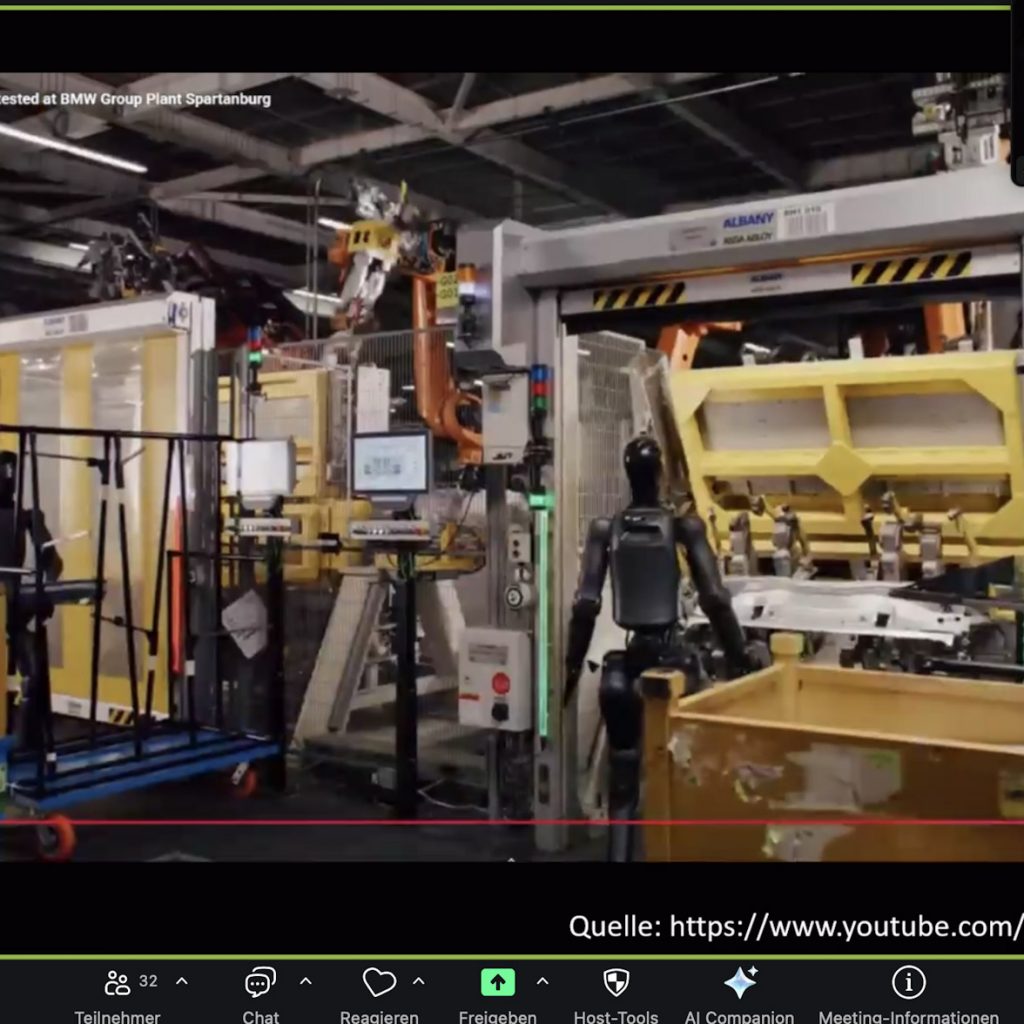
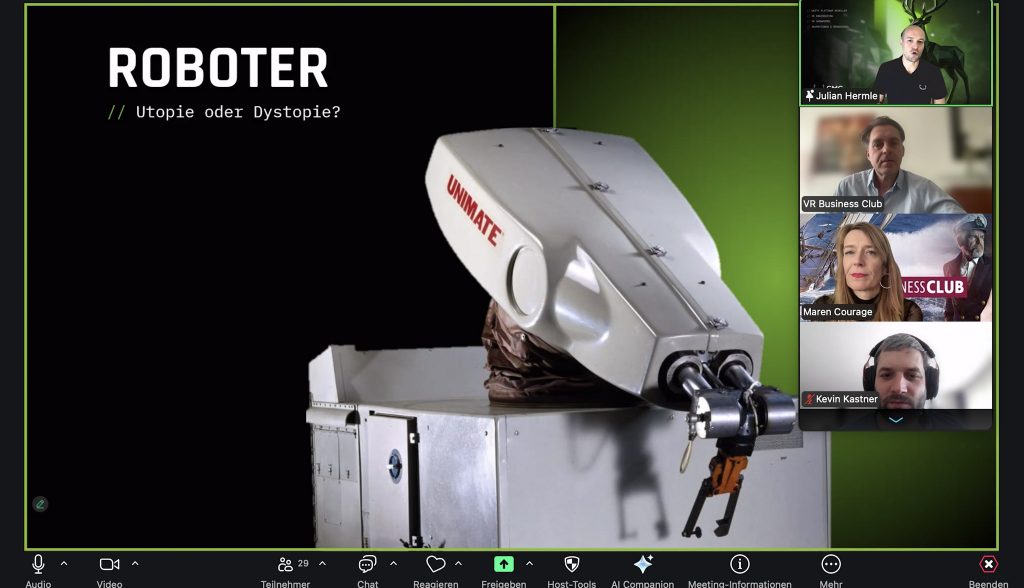
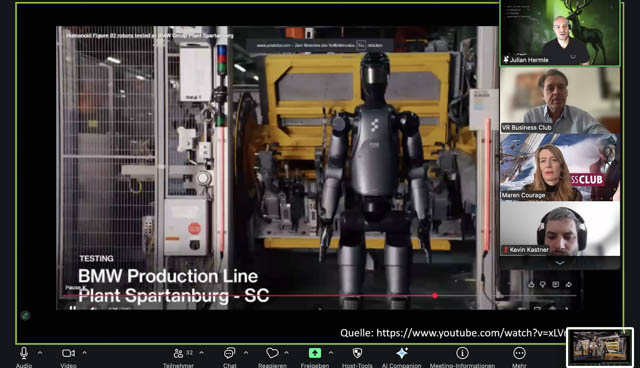
A brief look at the history of robotics spanned the arc from Unimate, the first industrial robot at Ford in 1961, to current humanoid robots such as Atlas and Figure. It became particularly clear how demanding real-world application scenarios are. Slippery floors, snow, and unpredictable environments continue to pose major challenges for autonomous systems.
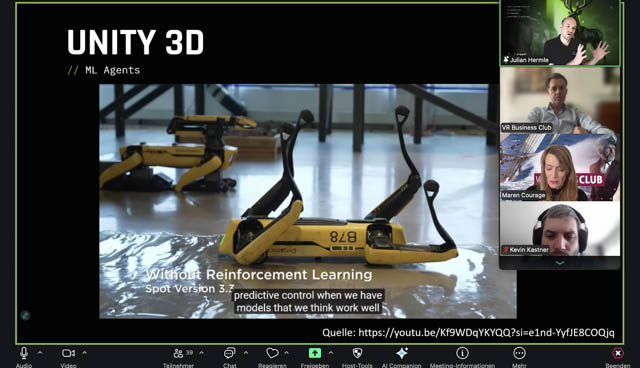
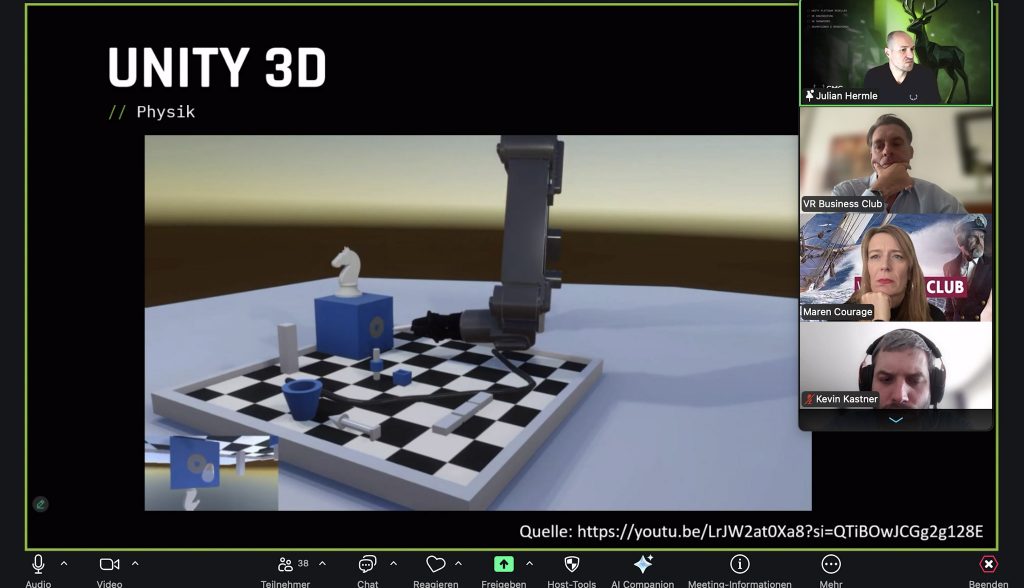
A central part of the presentation was devoted to the use of Unity 3D as a platform for industrial simulation and machine learning. Unity offers a low-threshold entry point, especially for small and medium-sized companies. ML Agents enable the training of autonomous systems directly in the simulation. Advantages include the large developer community, the simple C# programming language, and the ability to implement applications across platforms.
The benefits became tangible through concrete practical examples. Among other things, simulations of lidar sensors and driverless transport systems with hardware-in-the-loop, the generation of synthetic training data for package capture, energy-optimized behavior of harvesting machines, and research projects on gripping objects in bulk material at the Technical University of Munich were presented.
Technical aspects such as 3D scenarios, physics engines, virtual sensor technology such as lidar and computer vision, and reward and punishment systems for reinforcement learning were examined. An outlook also showed Open USD as a possible future standard for the exchange of complex simulation data.
Finally, Unity Industry Day was announced for March 5 in Hülben. There, participants can expect further insights into virtual sensor technology, physics simulation, and ML agents.
The VR Business Club Reality Connect with CMC Engineers made it clear that simulation first is more than just a trend. It is a new way of thinking that makes industrial development faster, safer, and more sustainable.