Recap: VR Business Club Reality Connect with
Peter Schopf
Tue. 5. May | 11:00 – 12:00 | Online
Many companies are experimenting with generative AI. Few are implementing it in a structured way. This is exactly where the Reality Connect Talk with Peter Schopf came in.
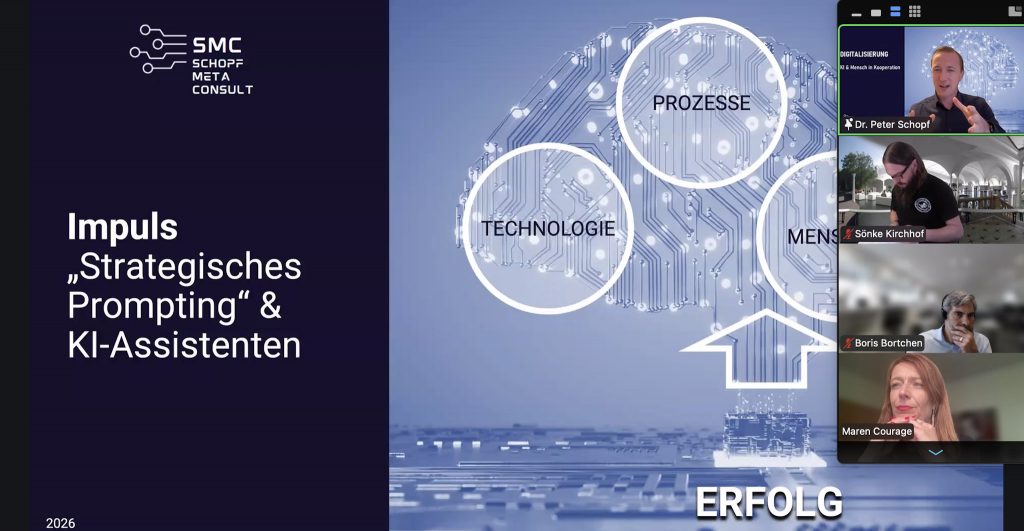
The focus was on a clear shift in perspective: away from individual tools and prompts, and toward systematically integrating AI into the organization, its processes, and its decision-making structures.
From Prompt to Agent
Peter Schopf presented a tried-and-tested step-by-step model that guides companies along a clear path of development:
- Strategic prompting as a starting point
- Specialized AI assistants for specific tasks
- Agent-based workflows for integration into processes
- Autonomous agents as a scalable target structure
The key point here is that added value does not come from technology alone, but from the way it is integrated.
Operational vs. strategic: The real lever
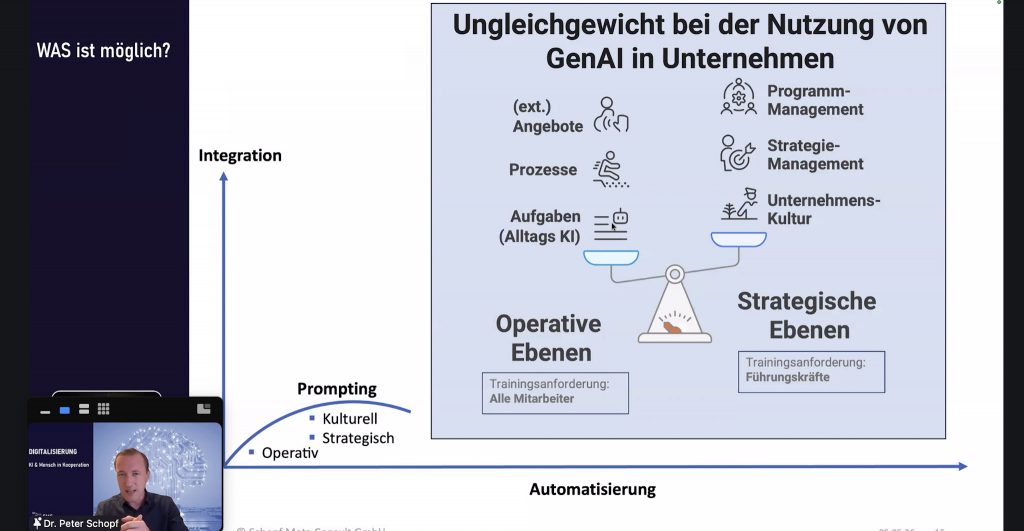
A key point of contention in the discussion was the distinction between operational and strategic uses of AI.
Operational applications automate tasks and improve efficiency.
Strategic applications go deeper. They support complex decision-making, structure thinking, and have a direct impact at the executive level.
According to Schopf, this is precisely where the greatest impact lies:
time savings of up to 20 percent for highly specialized roles, combined with better decision-making.
Why Experience Is More Important Than Technology
Another key point: Successful use of AI depends less on technical expertise than on the ability to provide context.
Experienced employees achieve better results than digital natives because they:
- be able to make sense of complex relationships
- formulate more precise questions
- provide relevant context
den entsprechenden Kontext liefern
AI as an Organizational Issue
Specific examples illustrated how companies are successfully implementing generative AI:
- Clear definition of objectives based on the “why”
- gradual integration into existing processes
- Focus on Roles and Responsibilities
- Avoiding isolated pilot projects that lack scalability
A real-world example demonstrated how AI was used in complaint management to achieve a roughly 50 percent increase in efficiency.
Outlook: Leadership Assistants and Avatars
As it came to a close, the view ahead opened up.
The focus will be on the following in the future:
- AI-powered leadership assistants
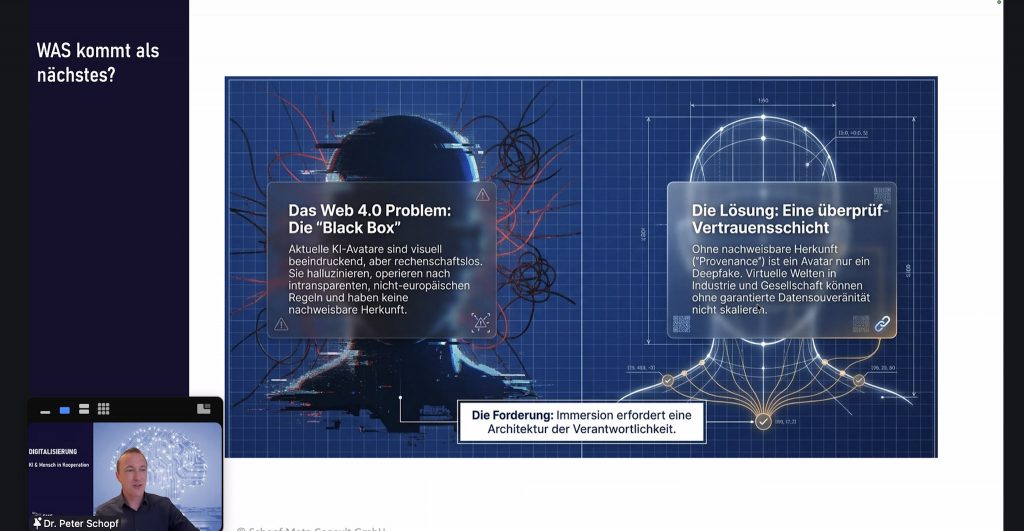
- Trustworthy avatars in virtual environments
- Organizational models in which AI is an integral part of the structure
A related EU Horizon project is currently in the planning stages.
Classification
The discussion highlighted a clear trend:
Generative AI will not prevail through tools, but through structure.
Companies that start early to build strategic prompting and agent-based systems are transforming not only efficiency but also the way decisions are made.